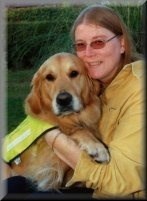
I met someone this week with an assistance dog from another UK training organisation, one of the main differences that I can see, between the rules of that organisation and the one my dog comes from (Dogs for the Disabled), is that we are allowed to travel abroad.
All the assistance dog organisations in the United Kingdom have been in existence since before the Pet Passport Scheme (PETS) was introduced for dogs and cats travelling from certain European countries on 28 February 2000. The Scheme was extended to Cyprus, Malta and certain long haul countries and territories on 31 January 2001. Bahrain joined on 1 May 2002. Mainland USA and Canada joined on 11 December 2002.
Naturally, there are health considerations with travelling abroad, but with common sense and enough reasearch and advice one can travel into and out of the UK with very little trouble at all. Caesar and I first travelled abroad in 2004, and the ability to have him with me, working in various countries that I have wished to travel to has enabled me to become truly independent and for both of us has been a very validating experience.
I cannot imagine how I would feel, ably assisted by my assistance dog within the confines of the UK but as soon as my advocacy work took me abroad we'd have to part company.
Surely, the whole object of becoming independent with the help of an assistance dog is freedom ... freedom to choose where one travels being included in that?
Naturally, all our travels are undertaken after a full assessment of the risks involved to both Caesar and myself, and of course we would not travel together if it meant he would suffer in any way ...
I'm really glad to have a dog from an organisation that understands the autonomy of partnership and doesn't treat partnerships in a paternalistic way, making rules which deny freedom.
Sunday, 10 February 2008

Food for thought.
It's been an interestng and thought provoking week ... I was told to expect my (rebuilt) wheelchair to be returned on Friday, needless to say, it's not back yet! Just as well I wasn't holding my breath! Ironically, on Friday I had a conversation with someone who told me about another mobility product being the subject of legal action because it was not deemed fit for the purpose ...
I had to travel to London for a meeting and duly booked the wheelchair space in the train well ahead of time ... only to find my pre-booked space was occupied, by a mother with a pram ... thankfully, there was another wheelchair space unoccupied, so I removed my reserved slip from the original space and moved to the vacant space. Fair enough, parents with prams need somewhere to sit, but what if the other wheelchair space had not been vacant, where would that have left me? This is a tricky one, the railway company advise people using wheelchairs to book ahead of time to reserve the space, yet someone with a pram can board the train with no notice and occupy it anyway ... perhaps if there was more room on the train for prams elsewhere we wouldn't see them occupying the disabled persons seats.
I had to travel to London for a meeting and duly booked the wheelchair space in the train well ahead of time ... only to find my pre-booked space was occupied, by a mother with a pram ... thankfully, there was another wheelchair space unoccupied, so I removed my reserved slip from the original space and moved to the vacant space. Fair enough, parents with prams need somewhere to sit, but what if the other wheelchair space had not been vacant, where would that have left me? This is a tricky one, the railway company advise people using wheelchairs to book ahead of time to reserve the space, yet someone with a pram can board the train with no notice and occupy it anyway ... perhaps if there was more room on the train for prams elsewhere we wouldn't see them occupying the disabled persons seats.
Tuesday, 5 February 2008
Assistance Dog featured on First Class Stamp!

There was a certain poignancy this morning as Caesar, my assistance dog brought the post to me in bed ... amongst the post was a first day cover featuring an assistance dog!

The dog in question is Rowan, a fellow Dog for the Disabled (who works assisting Melissa) and he is featured on the first class stamp. Great stuff!
The whole set of stamps features working dogs, the series having been launched to celebrate the 100th anniversary of the police dog. The dogs featured are an assistance dog from Dogs for the Disabled, a mountain rescue dog, a police dog, a customs dog and a second assistance dog from Guide Dogs.
Although in the Year of the Assistance Dog it would have been nice to see a whole set of stamps dedicated to assistance dogs in their own right, I think this set will do a lot to bring assistance dogs more into the consciousness of the general public, and hopefully that will have a knock on effect with regard to access and inclusion for people with disabilities partnered with these fantastic dogs.
Tuesday, 29 January 2008
More wheelchair woes!
The week before Christmas, my wheelchair, yes, the new one, went kaput again! After some negotiations, it was taken back by the manufacturers for checks and was returned apparently repaired.
All was well whilst I only used the chair indoors over Christmas, however on my second outing with it, the same front wheel buckled under again and rendered the chair pretty much useless.
I really don't understand what the problem is, young wheelchair using guys do all sorts of acrobatics in theirs and they are fine, but as a middle aged woman I don't seem to be able to hit the smallest of stones before it buckles under ... considering the chair was meant to have been built for me, to suit my size and so on, it doesn't really make any sense whatsoever.
So, back to the manufacturer for the fourth time (I think it is the fourth, starting to lose count), they have now apparently found a problem with it they missed last time and also finally have acknowledged my feeling that the frame was twisted. So, I have been without it for a fortnight and it isn't likely to be ready for at least another week.
I'm starting to feel like I have a lemon of a chair ... my previous ones have been made in Sweden and Switzerland but this time I was determined to buy British ... hmmmmmm!
Wednesday, 2 January 2008
Welcome 2008!
2008 has been designated the Year of the Assistance Dog in the United Kingdom!
Five charities which train assistance dogs in the United Kingdom have announced plans to designate 2008 Year of the Assistance Dog, campaigning for the rights of assistance dog partnerships.
The five organisations that comprise Assistance Dogs UK (ADUK); Dogs for the Disabled, Support Dogs, Canine Partners, Guide Dogs, and Hearing Dogs, will work together to promote rights of access to services for all assistance dog partnerships. Partnerships will be encouraged to nominate retailers, leisure facilities, public premises, parks and transport operators for Dog Stars, giving service providers with an incentive to make their premises assistance dog friendly.
Dog Star Awards will be symbols of service excellence, given in recognition that premises and services meet the needs of all assistance dog partnerships. For example, provision of wheelchair access, Braille menus for blind and partially-sighted people, induction loops for customers with hearing impairment, and of course – water bowls for assistance dogs!
On the whole access in the UK for assistance dog partnerships is good, but there remain challenges which can lead to disadvantage and unlawful discrimination towards partnerships, by highlighting good practice with Dog Star Awards it is hoped that such good practice will become the norm from service providers.
The Institute of Environmental Health Officers advises that assistance dogs should not be a risk to hygiene. These dogs are regularly groomed to the highest standard and the health and condition of every dog is checked regularly by a vet. It is the responsibility of the person partnered with the dog to ensure that their dog meet the highest level of hygiene.
Background
Since December 1996, it has been unlawful for hoteliers and restaurant owners to refuse to serve a disabled person or offer a lower standard of service for reasons related to the person’s disability. Since October 2004, the law also requires that service providers make reasonable adjustments to the physical features of their premises to overcome barriers to access.
Taxi drivers – since 31 March 2001 (31 March 2003 in Scotland) – are required to carry, free of charge, assistance dogs travelling with their owner. A similar duty has applied since 31 March 2004 to drivers and operators of private hire vehicles (private hire cars in Scotland).
Additionally, since 4 December 2006, under Part 3 of the Disability Discrimination Act (DDA), it has been unlawful for them to refuse service to a disabled person, or offer a lower standard of service for reasons related to the person’s disability. The law also requires them to make reasonable adjustments for disabled people in the way that their services are provided – though that does not include physical alterations to the vehicles.
Monday, 31 December 2007
Spare a thought for those vital animals as new year approach
Fireworks put fear into assistance dogs, please think of the consequences of letting them off in urban areas this new year.
read more | digg story
read more | digg story
Wednesday, 26 December 2007
Muslims break taboo to allow guide dog into mosque -Times Online
Interesting article about Guide Dogs for the Blind in the UK planning to place a guide dog with a Muslim teenager. Many different angles here as to what might be right and what might not be so good for the dog, certainly an interesting development.
read more | digg story
read more | digg story
Subscribe to:
Posts (Atom)